

Truncated multivariate normals: a tutorial
This notebook shows how to use Composed Multivariate Normal distributions (MoGs) when variables have finite support (e.g. \([0,1]\)).
Theoretical background
In real problems the domain of the variables is not infinite but bounded into a semi-finite region.
If we start from the unbounded multivariate normal distribution:
Let \(T\subset\{l,\dots,m\}\), where \(l\leq k\) and \(m\leq k\) be the set of indices of the truncated variables, and let \(a_i<b_i\) be the truncation bounds for \(i\in S\). Define the truncation region:
with the remaining coordinates \(i\notin T\) unbounded. The partially-truncated multivariate normal distribution is defined by
where \(\mathbf{1}_{A_T}\) is the indicator function of \(A_T\) and the normalization constant is
Installation and importing
If you’re running this in Google Colab or need to install the package, uncomment and run the following cell:
[1]:
try:
    from google.colab import drive
    %pip install -Uq multimin
except ImportError:
    print("Not running in Colab, skipping installation")
    %load_ext autoreload
    %autoreload 2
!mkdir -p gallery/

# Uncomment to install from GitHub (development version)
# !pip install git+https://github.com/seap-udea/MultiMin.git
Not running in Colab, skipping installation
[2]:
import multimin as mn
import numpy as np
import matplotlib.pyplot as plt
from IPython.display import Markdown, display

import warnings
warnings.filterwarnings("ignore")

figprefix = "truncated"
Welcome to MultiMin v0.11.2. ¡Al infinito y más allá!
1D distribution on a finite domain
Define a mixture of two Gaussians on the interval \([0, 1]\). Use the domain parameter: each variable can be None (unbounded) or [low, high].
[3]:
MoG_1d = mn.MixtureOfGaussians(
    mus=[0.2, 0.8],
    weights=[0.5, 0.5],
    Sigmas=[0.01, 0.03],
    domain=[[0, 1]]  # variable 0 bounded to [0, 1]
    #domain=[None]  # variable 0 bounded to [0, 1]
)
The parameters are:
[4]:
MoG_1d.tabulate()
[4]:
| w | mu_1 | sigma_1 | |
|---|---|---|---|
| component | |||
| 1 | 0.5 | 0.2 | 0.01 |
| 2 | 0.5 | 0.8 | 0.03 |
The function is:
[5]:
function, cmmd = MoG_1d.get_function()
import numpy as np
from multimin import Util

def mog(X):

    a = 0.0
    b = 1.0

    mu1_1 = 0.2
    sigma1_1 = 0.01
    n1 = Util.tnmd(X, mu1_1, sigma1_1, a, b)

    mu2_1 = 0.8
    sigma2_1 = 0.03
    n2 = Util.tnmd(X, mu2_1, sigma2_1, a, b)

    w1 = 0.5
    w2 = 0.5

    return (
        w1*n1
        + w2*n2
    )
Sample and plot: all points lie in \([0, 1]\).
[6]:
# properties: list (e.g. ["x"]) or dict like MultiPlot (label and optional range per key)
G = MoG_1d.plot_sample(
    properties=["x"],
    sargs=dict(s=0.5, alpha=0.5),
    figsize=3,
)
plt.savefig(f"gallery/{figprefix}_1d_sample.png")
MixtureOfGaussians.rvs executed in 0.7458367347717285 seconds
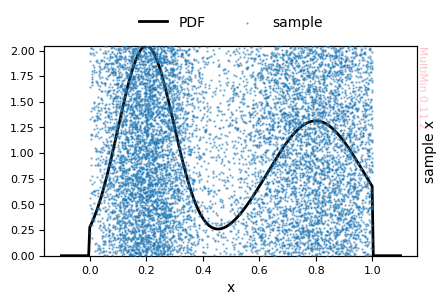
The PDF is zero outside the domain:
[7]:
print("PDF at 0.5 (inside):", MoG_1d.pdf(np.array([[0.5]])))
print("PDF at -0.1 (outside):", MoG_1d.pdf(np.array([[-0.1]])))
PDF at 0.5 (inside): 0.3160530018742784
PDF at -0.1 (outside): 0.0
Fitting 1D data on a finite domain
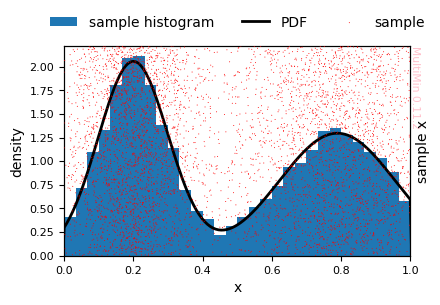
Generate data from the same distribution and fit with FitMoG(…, domain=[[0, 1]]). The fitter uses the domain in the likelihood and (by default) bounds the means to the domain.
[8]:
np.random.seed(42)
data_1d = MoG_1d.rvs(5000)

F_1d = mn.FitMoG(data=data_1d, ngauss=2, domain=[[0, 1]])
F_1d.fit_data(advance=10)
MixtureOfGaussians.rvs executed in 0.35561394691467285 seconds
Loading a FitMoG object.
Number of gaussians: 2
Number of variables: 1
Number of dimensions: 2
Number of samples: 5000
Domain: [[0, 1]]
Log-likelihood per point (-log L/N): 0.004026885720446497
Iterations:
Iter 0:
        Vars: [0.71, -0.71, 0.086, 0.92, -4.2, -4.2]
        LogL/N: 0.09798353864465152
Iter 10:
        Vars: [0.039, -0.037, 0.2, 0.78, -4.6, -4.1]
        LogL/N: -0.12867363221859465
Iter 20:
        Vars: [0.041, -0.038, 0.2, 0.79, -4.6, -4.1]
        LogL/N: -0.12932597694140233
FitMoG.fit_data executed in 0.12979698181152344 seconds
[9]:
F_1d.mog.tabulate(sort_by="weight")
[9]:
| w | mu_1 | sigma_1 | |
|---|---|---|---|
| component | |||
| 1 | 0.509835 | 0.199924 | 0.010318 |
| 2 | 0.490165 | 0.788830 | 0.028471 |
[10]:
F_1d.plot_fit(
    properties=["x"],
    ranges=[[0, 1]],
    hargs=dict(bins=30, cmap="Spectral_r"),
    sargs=dict(s=0.5, edgecolor="None", color="r"),
    figsize=3,
)
plt.savefig(f"gallery/{figprefix}_1d_fit.png")
[11]:
print("Fitted parameters:")
F_1d.mog.tabulate(sort_by="weight")
Fitted parameters:
[11]:
| w | mu_1 | sigma_1 | |
|---|---|---|---|
| component | |||
| 1 | 0.509835 | 0.199924 | 0.010318 |
| 2 | 0.490165 | 0.788830 | 0.028471 |
And the function:
[12]:
function, mog = F_1d.mog.get_function()
import numpy as np
from multimin import Util

def mog(X):

    a = 0.0
    b = 1.0

    mu1_1 = 0.199924
    sigma1_1 = 0.010318
    n1 = Util.tnmd(X, mu1_1, sigma1_1, a, b)

    mu2_1 = 0.78883
    sigma2_1 = 0.028471
    n2 = Util.tnmd(X, mu2_1, sigma2_1, a, b)

    w1 = 0.509835
    w2 = 0.490165

    return (
        w1*n1
        + w2*n2
    )
3D distribution with one variable on a finite domain
Use domain=[None, [0, 1], None]: variables 0 and 2 are unbounded; variable 1 is bounded to \([0, 1]\).
[13]:
weights = [0.5, 0.5]
mus = [[0.0, 0.3, 0.0], [0.0, 0.7, 0.0]]  # two bumps along the bounded variable (y)
sigmas = [[0.6, 0.15, 0.6], [0.6, 0.15, 0.6]]
Sigmas = [np.diag(s)**2 for s in sigmas]

MoG_3d = mn.MixtureOfGaussians(
    mus=mus,
    weights=weights,
    Sigmas=Sigmas,
    domain=[None, [0, 1], None],  # only variable 1 in [0, 1]
)
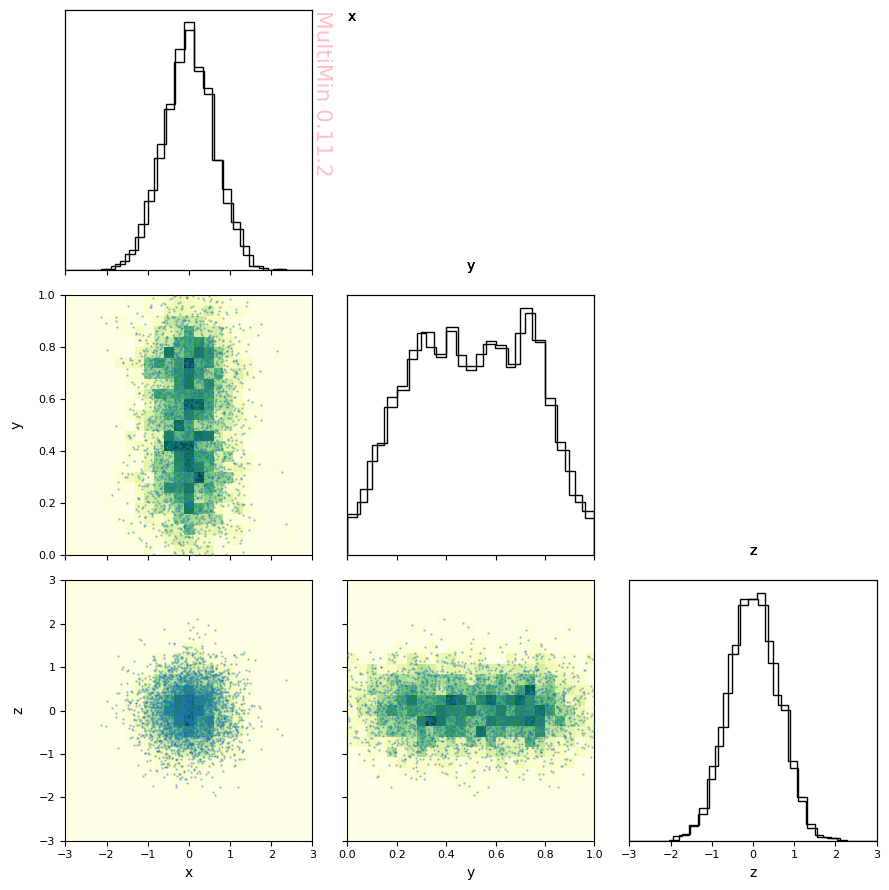
Samples: the first and third coordinates are unbounded; the second coordinate lies in \([0, 1]\).
[14]:
sample_3d = MoG_3d.rvs(3000)
print("Variable 1 (bounded) min/max:", sample_3d[:, 1].min(), sample_3d[:, 1].max())
print("All variable 1 in [0,1]:", np.all((sample_3d[:, 1] >= 0) & (sample_3d[:, 1] <= 1)))
MixtureOfGaussians.rvs executed in 0.33029699325561523 seconds
Variable 1 (bounded) min/max: 2.0159534563357617e-06 0.9988410207612409
All variable 1 in [0,1]: True
[15]:
G3 = MoG_3d.plot_sample(
    data=sample_3d,
    properties=["x", "y", "z"],
    ranges=[[-3, 3], [0, 1], [-3, 3]],
    figsize=3,
    hargs=dict(bins=25, cmap="YlGn"),
    sargs=dict(s=0.3, alpha=0.5),
    marginals=True,
)
plt.tight_layout()
plt.savefig(f"gallery/{figprefix}_3d_sample.png")
plt.show()
Fitting 3D data with a finite domain on one variable
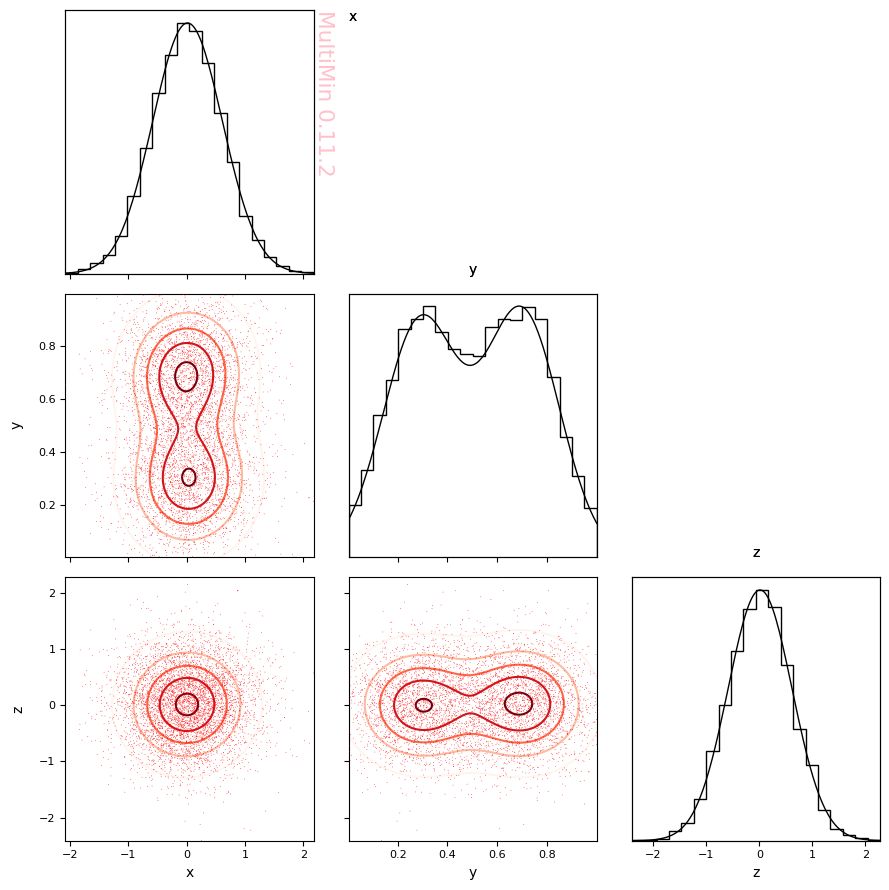
Fit with domain=[None, [0, 1], None] so the likelihood and mean bounds respect the second variable’s domain.
[16]:
np.random.seed(123)
data_3d = MoG_3d.rvs(5000)

F_3d = mn.FitMoG(data=data_3d, ngauss=2, domain=[None, [0, 1], None])
F_3d.fit_data(advance=30)
MixtureOfGaussians.rvs executed in 0.3601219654083252 seconds
Loading a FitMoG object.
Number of gaussians: 2
Number of variables: 3
Number of dimensions: 6
Number of samples: 5000
Domain: [None, [0, 1], None]
Log-likelihood per point (-log L/N): 2.27007315804755
Iterations:
Iter 0:
        Vars: [-0.025, 0.025, 0.05, 0.12, 0.029, 0.64, 0.87, 0.65, -2.2, -4.4, -2.2, -2.2, -4.4, -2.2, 0.65, 1.3, 0.64, 0.9, 1.2, 0.89]
        LogL/N: 3.0902091187997494
Iter 30:
        Vars: [0.08, -0.079, 0.033, 0.3, 0.0027, -0.0039, 0.71, 0.026, -2.7, -4.1, -2.8, -2.8, -4.2, -2.7, -0.018, 0.033, -0.018, 0.065, 0.025, -0.0022]
        LogL/N: 1.7362013544790753
Iter 60:
        Vars: [-0.025, 0.032, 0.043, 0.29, -0.0019, -0.0066, 0.7, 0.027, -2.7, -4.2, -2.8, -2.8, -4.2, -2.7, 0.04, 0.011, -0.022, 0.076, 0.039, -0.021]
        LogL/N: 1.7358856067279056
Iter 75:
        Vars: [-0.039, 0.046, 0.042, 0.29, -0.0027, -0.0056, 0.7, 0.027, -2.7, -4.2, -2.8, -2.8, -4.2, -2.7, 0.031, 0.012, -0.026, 0.068, 0.038, -0.022]
        LogL/N: 1.7358797044214596
FitMoG.fit_data executed in 3.224281072616577 seconds
[17]:
F_3d.plot_fit(
    properties=["x", "y", "z"],
    ranges=[[-3, 3], [0, 1], [-3, 3]],
    pargs=None,
    sargs=dict(s=0.3, edgecolor="None", color="r"),
    cargs=dict(),
    figsize=3,
    marginals=True,
)
plt.tight_layout()
plt.savefig(f"gallery/{figprefix}_3d_fit.png")
plt.show()
[18]:
MoG_3d.tabulate(sort_by="distance")
[18]:
| w | mu_1 | mu_2 | mu_3 | sigma_1 | sigma_2 | sigma_3 | rho_12 | rho_13 | rho_23 | |
|---|---|---|---|---|---|---|---|---|---|---|
| component | ||||||||||
| 1 | 0.5 | 0.0 | 0.3 | 0.0 | 0.6 | 0.15 | 0.6 | 0.0 | 0.0 | 0.0 |
| 2 | 0.5 | 0.0 | 0.7 | 0.0 | 0.6 | 0.15 | 0.6 | 0.0 | 0.0 | 0.0 |
[19]:
print("Fitted parameters (note variable 2 = y in [0,1]):")
F_3d.mog.tabulate(sort_by="distance")
Fitted parameters (note variable 2 = y in [0,1]):
[19]:
| w | mu_1 | mu_2 | mu_3 | sigma_1 | sigma_2 | sigma_3 | rho_12 | rho_13 | rho_23 | |
|---|---|---|---|---|---|---|---|---|---|---|
| component | ||||||||||
| 1 | 0.489455 | 0.042126 | 0.291250 | -0.002683 | 0.605644 | 0.150459 | 0.595910 | 0.015416 | 0.005950 | -0.013201 |
| 2 | 0.510545 | -0.005589 | 0.699513 | 0.026577 | 0.591069 | 0.151054 | 0.610339 | 0.033821 | 0.018985 | -0.010914 |
And the function is:
[20]:
function, mog = F_3d.mog.get_function()
import numpy as np
from multimin import Util

def mog(X):

    a = [-np.inf, 0.0, -np.inf]
    b = [np.inf, 1.0, np.inf]

    mu1_1 = 0.042126
    mu1_2 = 0.29125
    mu1_3 = -0.002683
    mu1 = [mu1_1, mu1_2, mu1_3]
    Sigma1 = [[0.366805, 0.001405, 0.002147], [0.001405, 0.022638, -0.001184], [0.002147, -0.001184, 0.355108]]
    Z1 = 0.973549
    n1 = Util.tnmd(X, mu1, Sigma1, a, b, Z=Z1)

    mu2_1 = -0.005589
    mu2_2 = 0.699513
    mu2_3 = 0.026577
    mu2 = [mu2_1, mu2_2, mu2_3]
    Sigma2 = [[0.349362, 0.00302, 0.006849], [0.00302, 0.022817, -0.001006], [0.006849, -0.001006, 0.372513]]
    Z2 = 0.976663
    n2 = Util.tnmd(X, mu2, Sigma2, a, b, Z=Z2)

    w1 = 0.489455
    w2 = 0.510545

    return (
        w1*n1
        + w2*n2
    )
[21]:
X = np.array([[0.0, 0.3, 1.2]])
mog(X), F_3d.mog.pdf(X)
[21]:
(0.07924013295046034, 0.07924082072895162)
And in LaTeX:
[22]:
function, _ = F_3d.mog.get_function(type="latex")
display(Markdown(function))
Finite domain. The following variables are truncated (the rest are unbounded):

- Variable $x_{2}$ (index 2): domain $[0.0, 1.0]$.

Truncation region: $A_T = \{\tilde{U} \in \mathbb{R}^k : a_i \le \tilde{U}_i \le b_i \;\forall i \in T\}$, with $T$ the set of truncated indices.

$$f(\mathbf{x}) = w_1 \, \mathcal{TN}_T(\mathbf{x}; \boldsymbol{\mu}_1, \mathbf{\Sigma}_1, \mathbf{a}_T, \mathbf{b}_T) + w_2 \, \mathcal{TN}_T(\mathbf{x}; \boldsymbol{\mu}_2, \mathbf{\Sigma}_2, \mathbf{a}_T, \mathbf{b}_T)$$

where

Bounds (vectors): $\mathbf{a}_T = (-\infty, 0.0, -\infty)^\top$, $\mathbf{b}_T = (\infty, 1.0, \infty)^\top$.

$$w_1 = 0.489455$$
$$\boldsymbol{\mu}_1 = \left( \begin{array}{c} 0.042126 \\ 0.29125 \\ -0.002683 \end{array}\right)$$
$$\mathbf{\Sigma}_1 = \left( \begin{array}{ccc} 0.366805 & 0.001405 & 0.002147 \\ 0.001405 & 0.022638 & -0.001184 \\ 0.002147 & -0.001184 & 0.355108 \end{array}\right)$$

$$w_2 = 0.510545$$
$$\boldsymbol{\mu}_2 = \left( \begin{array}{c} -0.005589 \\ 0.699513 \\ 0.026577 \end{array}\right)$$
$$\mathbf{\Sigma}_2 = \left( \begin{array}{ccc} 0.349362 & 0.00302 & 0.006849 \\ 0.00302 & 0.022817 & -0.001006 \\ 0.006849 & -0.001006 & 0.372513 \end{array}\right)$$

Truncated normal. The unbounded normal is

$$\mathcal{N}(\mathbf{x}; \boldsymbol{\mu}, \mathbf{\Sigma}) = \frac{1}{\sqrt{(2\pi)^{{k}} \det \mathbf{\Sigma}}} \exp\left[-\frac{1}{2}(\mathbf{x}-\boldsymbol{\mu})^{\top} \mathbf{\Sigma}^{{-1}} (\mathbf{x}-\boldsymbol{\mu})\right].$$

The truncation region is $A_T = \{\tilde{U} \in \mathbb{R}^k : a_i \le \tilde{U}_i \le b_i \;\forall i \in T\}$. The partially truncated normal is

$$\mathcal{TN}_T(\tilde{U}; \tilde{\mu}, \Sigma, \mathbf{a}_T, \mathbf{b}_T) = \frac{\mathcal{N}(\tilde{U}; \tilde{\mu}, \Sigma) \, \mathbf{1}_{A_T}(\tilde{U})}{Z_T(\tilde{\mu}, \Sigma, \mathbf{a}_T, \mathbf{b}_T)},$$

where $\mathbf{1}_{A_T}$ is the indicator of $A_T$ and the normalization constant is

$$Z_T(\tilde{\mu}, \Sigma, \mathbf{a}_T, \mathbf{b}_T) = \int_{A_T} \mathcal{N}(\tilde{T}; \tilde{\mu}, \Sigma) \, d\tilde{T} = \mathbb{P}_{\tilde{T} \sim \mathcal{N}(\tilde{\mu},\Sigma)}(\tilde{T} \in A_T).$$
Finite domain. The following variables are truncated (the rest are unbounded):
Variable \(x_{2}\) (index 2): domain \([0.0, 1.0]\).
Truncation region: \(A_T = \{\tilde{U} \in \mathbb{R}^k : a_i \le \tilde{U}_i \le b_i \;\forall i \in T\}\), with \(T\) the set of truncated indices.
where
Bounds (vectors): \(\mathbf{a}_T = (-\infty, 0.0, -\infty)^\top\), \(\mathbf{b}_T = (\infty, 1.0, \infty)^\top\).
Truncated normal. The unbounded normal is
The truncation region is \(A_T = \{\tilde{U} \in \mathbb{R}^k : a_i \le \tilde{U}_i \le b_i \;\forall i \in T\}\). The partially truncated normal is
where \(\mathbf{1}_{A_T}\) is the indicator of \(A_T\) and the normalization constant is
Finite domain. The following variables are truncated (the rest are unbounded):
Variable \(x_2\) (index 2): domain \([0.0, 1.0]\).
Truncation region: \(A_T = \{\tilde{U} \in \mathbb{R}^k : a_i \le \tilde{U}_i \le b_i \;\forall i \in T\}\), with \(T\) the set of truncated indices.
where
Bounds (vectors): \(\mathbf{a}_T = (-\infty, 0.0, -\infty)^\top\), \(\mathbf{b}_T = (\infty, 1.0, \infty)^\top\).
Truncated normal. The unbounded normal is
The truncation region is \(A_T = \{\tilde{U} \in \mathbb{R}^k : a_i \le \tilde{U}_i \le b_i \;\forall i \in T\}\). The partially truncated normal is
where \(\mathbf{1}_{A_T}\) is the indicator of \(A_T\) and the normalization constant is